

Facility Management Market Share to Reach $2,750.87 Billion by 2034 | CAGR 8.50% during 2026-2034
Facility Management Market Size
Facility Management Market Share
Global facility management market poised to grow from USD 1,367.96 billion in 2025 to USD 2,750.87 billion by 2034 at a CAGR of 8.50%
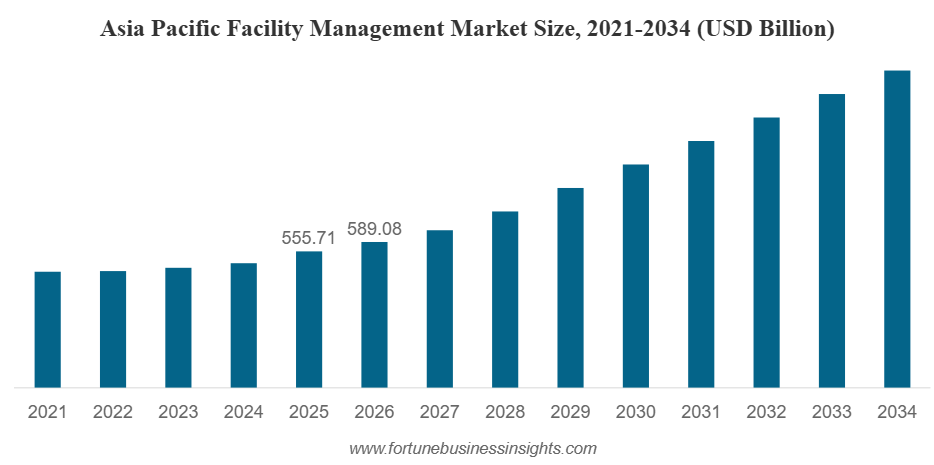
NEW YORK, NY, UNITED STATES, February 9, 2026 /EINPresswire.com/ -- The global facility management market size was valued at USD 1,367.96 billion in 2025 and is projected to grow from USD 1,435.13 billion 2026 to USD 2,750.87 billion by 2034, exhibiting a CAGR of 8.50% during the forecast period. The Asia Pacific dominated the Facility Management Market with a share of 40.60% in 2025.Get a Free Sample PDF: https://www.fortunebusinessinsights.com/enquiry/request-sample-pdf/facility-management-market-101658
The Facility Management (FM) market encompasses a wide range of tools and services that support the functionality, safety, and sustainability of buildings, grounds, infrastructure, and real estate. The market is transitioning from a traditional model of simple cleaning and repairs to a strategic discipline centered on workplace experience, energy management, and smart building technologies. The scope includes both Hard Services (mechanical, electrical, plumbing) and Soft Services (cleaning, security, catering).
Key Market Insights
The facility management (FM) market is undergoing significant transformation driven by evolving business priorities and technological advancements. A major trend is the growing shift from in-house facility management to outsourced services, as organizations increasingly concentrate on their core business competencies while seeking cost efficiency and operational expertise from specialized FM providers. At the same time, rapid technology integration is reshaping service delivery, with artificial intelligence, the Internet of Things, and big data analytics enabling a transition from traditional reactive maintenance to predictive and proactive maintenance models. Sustainability has also become a central focus, as Environmental, Social, and Governance (ESG) compliance is now a top priority for FM providers, influencing procurement decisions and service strategies. Furthermore, the rise of hybrid work models following the pandemic has expanded the scope of facility management, requiring providers to manage flexible workspaces, ensure employee health and safety, and support overall workforce well-being, thereby redefining the role of FM in modern organizations.
Market Trends
The facility management landscape is increasingly shaped by integrated, technology-driven, and wellness-focused approaches. Large enterprises are moving away from fragmented, single-service contracts and adopting Integrated Facility Management (IFM) models, where a single service provider oversees all facility-related functions, improving coordination, cost control, and accountability. At the same time, the rise of smart buildings is accelerating, with widespread adoption of sensors and Internet of Things (IoT) devices to enable real-time monitoring of HVAC systems, lighting, and space occupancy, thereby optimizing energy use and operational efficiency. Sustainability is another critical driver, as organizations increasingly adopt green cleaning practices using eco-friendly agents and retrofit existing buildings with energy-efficient systems to align with net-zero carbon objectives. Additionally, wellness-centric design has gained strong momentum, with greater emphasis on indoor air quality, lighting comfort, and biophilic design elements. These initiatives aim to create healthier indoor environments that enhance occupant comfort, productivity, and overall workplace experience.
Market Growth Factors
• Construction and Infrastructure Boom: Rapid urbanization in developing economies (particularly APAC and the Middle East) creates a direct demand
for FM services.
• Demand for Cost Optimization: Businesses are under pressure to reduce operational expenditure (OPEX), driving the demand for efficient, outsourced
FM solutions.
• Regulatory Compliance: Stricter government regulations regarding safety, waste management, and energy consumption require professional FM
expertise.
• Cloud-Based Software Adoption: The proliferation of CAFM (Computer-Aided Facility Management) and IWMS (Integrated Workplace Management Systems) boosts market efficiency.
Segmentation Analysis
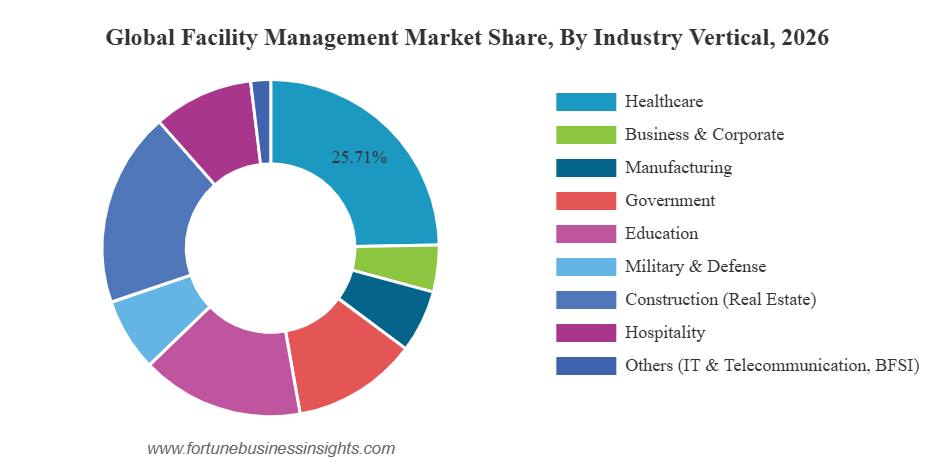
The facility management market is segmented based on offering, service type, and industry vertical. By offering, services are broadly categorized into hard services and soft services. Hard services include essential technical and mechanical functions such as HVAC, electrical systems, plumbing, and mechanical maintenance, which are critical for building safety and operational continuity. Soft services, on the other hand, cover non-technical but equally important activities such as cleaning, security, catering, and waste management that support daily operations and occupant comfort. By service type, facility management can be delivered through in-house teams or outsourced models, with outsourcing further classified into single-service, bundled, and integrated service arrangements, reflecting growing demand for comprehensive solutions. By industry vertical, the commercial sector—including offices and retail spaces—currently holds the largest market share, driven by high demand for professional facility services, while industrial and institutional sectors such as manufacturing, logistics, education, healthcare, and government also contribute significantly to overall market growth.
Speak to Analyst: https://www.fortunebusinessinsights.com/enquiry/speak-to-analyst/facility-management-market-101658
Regional Analysis
• North America: Dominated by the U.S., this is a mature market with high adoption of advanced FM technologies and IFM contracts.
• Asia-Pacific: The fastest-growing region due to massive infrastructure development in China and India, and rising organized real estate sectors.
• Europe: Market growth is driven heavily by stringent environmental regulations and a focus on energy efficiency in older building stock.
• Middle East & Africa: Growth driven by mega-projects (e.g., in Saudi Arabia and UAE) and a shift toward economic diversification.
Key Industry Players
• Sodexo (France)
• CBRE Group, Inc. (U.S.)
• ISS A/S (Denmark)
• Compass Group (U.K.)
• Aramark (U.S.)
• Jones Lang LaSalle IP, Inc. (U.S.)
• Johnson Controls International plc. (Ireland)
• Cushman & Wakefield (U.S.)
• Dussmann Group (Germany)
• Tenon Group (India)
• OCS Group International Limited (U.K.)
• EFS Facilities Services Group (UAE)
• Veolia Environment (France)
• American Facility Services Group (U.S.)
Key Industry Developments
• February 2024 - CBRE Group, Inc. and Arlington Capital Partners acquired J&J Worldwide Services, a company involved in base support operations facilities maintenance for the U.S. federal government from Arlington along with engineering services.
• March 2023 - ISS entered into a five-year contract to provide integrated facilities services (IFS) to a U.S. based pharmaceutical company with global reach.
Future Outlook
The Facility Management market is poised for robust growth through 2034. The future will be defined by data-driven decision-making, where buildings "talk" to facility managers. We expect a surge in demand for flexible workspace solutions and carbon-neutral facility operations. Providers that offer a seamless blend of human hospitality and technological efficiency will capture the highest market share.
Read Related Insights:
Hard Services Facility Management Market
Soft Services Facilities Management Market
Ashwin Arora
Fortune Business Insights™ Pvt. Ltd.
+1 833-909-2966
sales@fortunebusinessinsights.com
Legal Disclaimer:
EIN Presswire provides this news content "as is" without warranty of any kind. We do not accept any responsibility or liability for the accuracy, content, images, videos, licenses, completeness, legality, or reliability of the information contained in this article. If you have any complaints or copyright issues related to this article, kindly contact the author above.
